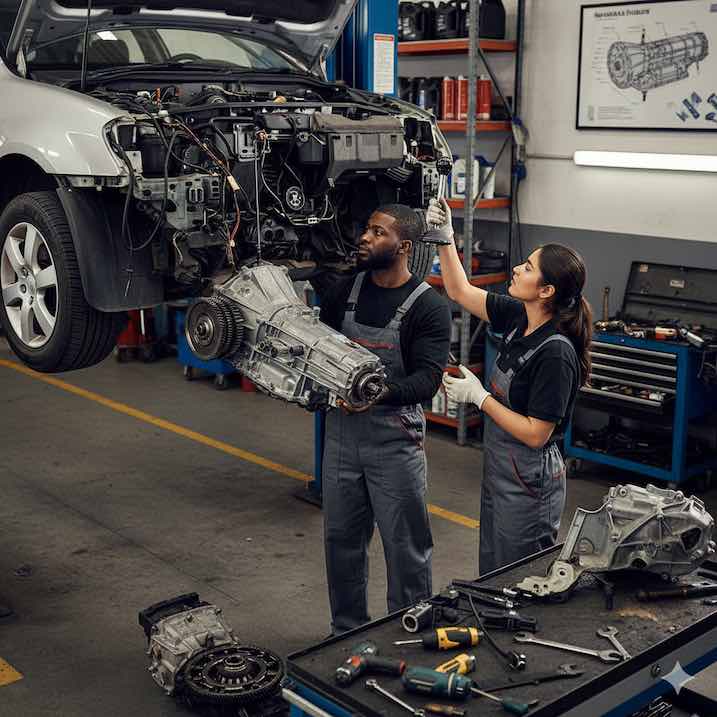
Converting an automatic transmission car to a manual is a technically demanding project that blends mechanical engineering, electrical modification, and precise calibration. It's possible — but not always practical — depending on the car's design, availability of parts, and legal context in your country (e.g., Kenya). Below is an in-depth, part-by-part and process-based breakdown of what's involved.
1. Core Components Required for Conversion
To successfully swap from an automatic to manual transmission, you need several major assemblies and supporting components. Each must be compatible with your car's engine and drivetrain.
Main Parts:
-
Manual Transmission Gearbox:
The heart of the swap. Must match your engine model and ECU (e.g., if converting a Toyota 1NZ-FE automatic, you'll need a compatible C50 or C56 manual gearbox).
-
Clutch Kit (Clutch Disc, Pressure Plate, Release Bearing):
Transfers power between the engine and gearbox when you engage or release the clutch pedal.
-
Flywheel:
Replaces the automatic transmission's torque converter. Manual flywheels are lighter and have a clutch-mounting surface.
-
Clutch Pedal Assembly and Master Cylinder:
Includes the pedal, hydraulic lines, and slave cylinder to engage/disengage the clutch.
-
Gear Lever (Shifter) and Linkage Assembly:
Connects the gear lever to the gearbox. Each model has a specific linkage or cable system.
-
Manual Transmission Mounts and Brackets:
Automatics and manuals often use different mounts to secure the transmission to the chassis.
-
Driveshaft (or Axles):
Depending on the gearbox type, you may need different driveshafts with correct spline counts or lengths.
-
ECU (Engine Control Unit):
Automatics use a Transmission Control Module (TCM). You'll need either:
-
Instrument Cluster (Optional):
Some automatic clusters show PRNDL indicators. You can swap it for a manual version, though this is mostly aesthetic.
-
Miscellaneous:
-
Transmission fluid specific to the manual gearbox
-
Clutch fluid (DOT 3/4 brake fluid)
-
New bolts, seals, and gaskets
2. Mechanical & Electrical Work Involved
Mechanical Tasks
-
Remove the automatic transmission, torque converter, and related wiring.
-
Install the manual flywheel and clutch assembly.
-
Fit the manual gearbox, mounts, and linkage.
-
Modify or replace the driveshafts if needed.
-
Drill or cut holes in the firewall for clutch master cylinder (in vehicles that didn't originally have one).
Electrical Modifications
-
Bypass or disable the neutral safety switch (prevents starting unless in 'P' or 'N').
-
Wire in a clutch start switch (for safety, allows engine to start only when clutch is pressed).
-
Update or reprogram ECU if it throws errors for missing automatic transmission sensors.
-
Adjust the reverse light switch wiring to connect to the manual gearbox sensor.
3. Legal Considerations (Kenyan Context)
In Kenya, NTSA regulations do not explicitly prohibit gearbox conversions — but any change in drivetrain type (automatic ? manual) technically counts as a major modification.
-
The car should undergo inspection at a certified NTSA inspection center after modification.
-
The logbook (RC) should reflect "manual transmission" to maintain insurance validity and road legality.
-
It's advisable to have a qualified garage perform the swap and provide a technical report.
Failure to declare such modifications could invalidate insurance claims if an accident occurs.
4. Common Problems After Conversion — and Fixes
| Problem | Likely Cause | How to Fix It |
| ECU confusion / Check Engine Light | Missing auto sensors (e.g., gear position) | Reflash or replace ECU with manual version |
| Hard clutch or poor engagement | Improper clutch hydraulics or pedal ratio | Adjust or replace master/slave cylinder |
| Vibrations or misalignment | Incorrect mount angles or driveshaft imbalance | Re-align transmission mounts; replace worn mounts |
| Speedometer not working | Different speed sensor connectors | Adapt wiring or use correct sensor |
| Gear slipping or popping out | Used or mismatched gearbox | Replace gearbox or check linkage alignment |
| Leaks | Reused seals or old gaskets | Replace all seals during installation |
5. Skill Level and Recommended Approach
This is not a beginner DIY project.
You'll need:
-
Intermediate-to-advanced mechanical skills
-
Access to a lift or transmission jack
-
Understanding of hydraulic and electrical systems
If done poorly, the car may suffer from:
-
Misaligned drivetrain
-
Poor clutch feel
-
ECU malfunctions
-
Reduced resale value
It's best handled by:
-
A qualified transmission specialist, or
-
Performance workshops experienced with swaps (especially those familiar with Toyota, Subaru, or Nissan models common in Kenya).
6. Should You Do It?
Pros:
Cons:
-
Expensive (KSh 120,000–300,000+ in parts/labor)
-
Complex wiring
-
Possible legal hurdles
-
Reduced resale appeal unless done cleanly
Bottom Line:
Converting from automatic to manual is possible, but rarely practical for most Kenyan car owners unless for motorsport or personal preference. The reliability and drivability depend heavily on the quality of parts, mechanical skill, and post-conversion tuning.
If you love engaging driving and have the budget, go for it — but ensure it's professionally executed and legally documented.


0 Comments:
Post a Comment
Subscribe to Post Comments [Atom]
<< Home